Before the frame there was the wall. The load-bearing wall is architecture’s oldest sentence, a continuous act of resistance in which mass, gravity and opening are arranged into a syntax the eye reads without translation. To understand it is to understand where building begins.
Mass That Means Something
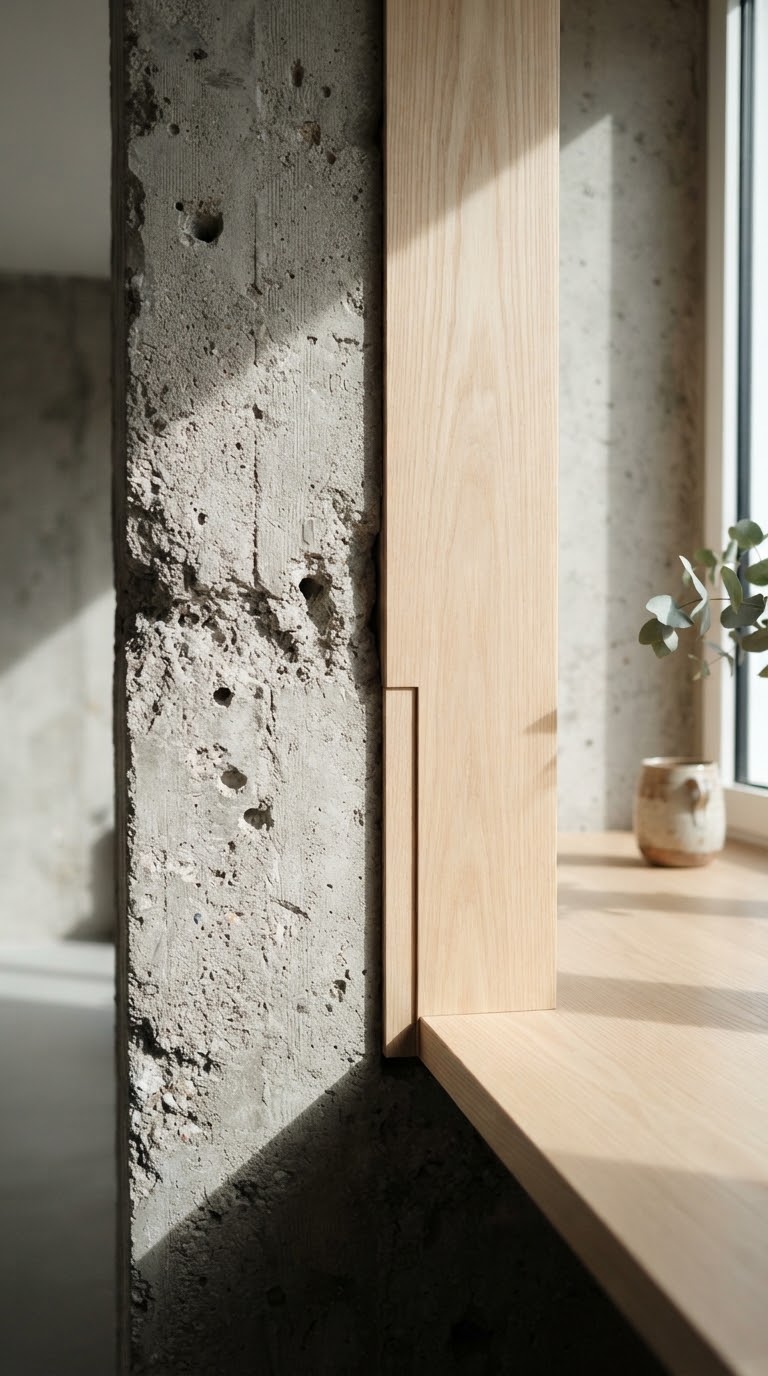
A load-bearing wall carries itself and everything above it down to the ground in an unbroken line. This simple fact governs everything else about it. The wall thickens toward its base because the accumulated weight demands more material there, and this taper, subtle though it often is, gives the elevation a sense of standing rather than merely existing. Mass is not inertia here; it is the visible evidence of forces being patiently gathered and delivered to the earth.
The rationalist reading of such a wall treats thickness as meaning. Where a partition can be thin because it carries nothing, the structural wall wears its depth openly, revealing its role in the reveal of every window. The eye learns to distinguish the two instinctively, and a plan composed of honest walls becomes legible in section long before a single label is added.
The Syntax of the Opening
Every opening in a load-bearing wall is a negotiation. Remove material for a window and the load must find its way around the void, which is why the lintel, the arch and the relieving beam are not decorative but grammatical. They are the connectives that allow the sentence of the wall to continue past an interruption without collapsing into nonsense.
This is why openings in a true masonry wall tend to be vertical, stacked and disciplined. The wall wants continuous paths of compression between them, and the composition of a facade becomes, at least in part, a diagram of where the wall can afford to be absent. A window is thus never simply a hole; it is a considered pause in a continuous structural argument.
A wall that carries load cannot lie about where its openings belong.
Études Studio
Compression and Its Comforts
Masonry is superb in compression and hopeless in tension, and the load-bearing wall is built entirely around this temperament. Stone, brick and rammed earth ask only to be squeezed, and when they are treated accordingly they endure for centuries with almost no maintenance. The grammar of such walls is therefore a grammar of stacking, of bringing weight down through material that is happiest under pressure.
There is a particular comfort in a building assembled this way. The thermal mass moderates the swings of the day, the surfaces age into texture rather than failure, and the interior acquires an acoustic calm that lightweight construction rarely matches. These are not incidental benefits; they follow directly from choosing to build in compression and letting the material work as it wishes.
- Continuity: Load must reach the ground in an unbroken path, so the wall thinks in vertical lines.
- Aperture: Every opening is bridged by a lintel or arch that keeps the compressive story intact.
- Mass: Thickness expresses duty; a wall that carries more is honestly permitted to be deeper.
- Endurance: Built purely in compression, masonry ages into texture rather than sudden failure.
Reading the Old Walls Anew
The contemporary return to load-bearing construction is not nostalgia but arithmetic. Structural masonry and, increasingly, structural timber and unfired earth carry lower embodied carbon than the framed alternatives, and they do so while producing interiors of genuine substance. The rationalist designer reaches for the load-bearing wall not to imitate the past but because its logic remains unimprovably direct.
To build a wall that carries its own weight is to accept a discipline that repays study. The plan must resolve into stable stacks of material, the openings must line up, the loads must find the ground. Within that discipline, however, lies an extraordinary freedom, because a wall that is honest about its structure needs no further justification. It simply stands, and in standing, it speaks a grammar we have understood for as long as we have built at all, and will go on understanding long after this season’s fashions have been forgotten.